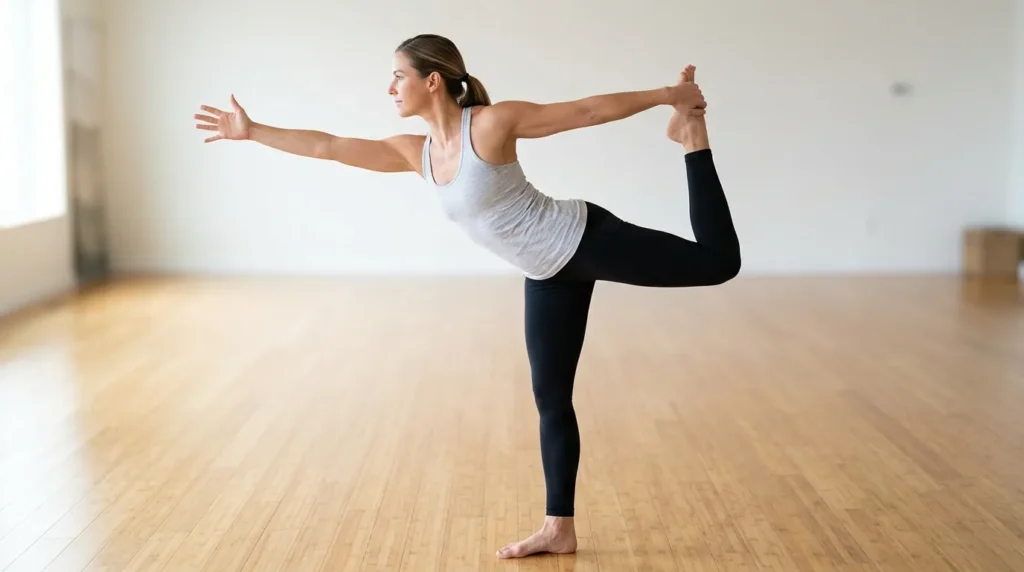

Imagine standing on one leg, extending the other leg behind you, opening your chest, and finding perfect balance while feeling both strong and graceful. At first, it may seem challenging, but with practice, this movement can become one of the most rewarding yoga poses in your fitness journey. This posture is known as Dancer Pose, or Natarajasana, one of the most recognized balancing poses in yoga.
Many beginners start yoga to improve flexibility, lose weight, reduce stress, or enhance overall fitness and wellness. However, they often discover that balance and body control are just as important as strength and flexibility. Dancer Pose Yoga helps develop all these qualities in a single movement. It combines balance, concentration, flexibility, posture improvement, and muscular strength.
This Dancer Pose Yoga Guide explains everything beginners need to know about Natarajasana, including its benefits, proper technique, daily practice routines, common mistakes, yoga variations, advantages, limitations, and practical fitness applications. Whether you are a yoga learner, athlete, gym user, or health-conscious individual, this guide will help you safely incorporate Dancer Pose into your fitness with yoga routine.
What is Dancer Pose Yoga?
Dancer Pose, known in Sanskrit as Natarajasana, is a standing balancing posture that combines flexibility, strength, coordination, and focus.
The pose is inspired by Lord Shiva’s cosmic dance, symbolizing balance, grace, and transformation. In the posture, one foot remains grounded while the opposite leg lifts behind the body. One hand holds the raised foot while the other arm extends forward.
Key Features of Dancer Pose
- Single-leg balance
- Backbend movement
- Hip opening stretch
- Shoulder mobility exercise
- Core engagement
- Focus and concentration training
Dancer Pose is commonly included in Hatha Yoga, Vinyasa Yoga, Power Yoga, and advanced balance sequences.
Benefits of Dancer Pose Yoga
Dancer Pose offers numerous physical and mental benefits.
Physical Health Benefits
Regular practice can improve:
- Flexibility
- Balance
- Coordination
- Posture
- Core strength
- Leg stability
The pose stretches multiple muscle groups while strengthening supporting muscles.
Mental Health Benefits
Balancing poses require concentration.
Mental benefits include:
- Improved focus
- Better mindfulness
- Reduced stress
- Enhanced mental discipline
- Greater self-confidence
Many practitioners find the pose calming despite its physical challenge.
Weight Loss Support
While Dancer Pose alone will not produce major weight loss, it supports healthy fitness goals by:
- Increasing muscular engagement
- Improving workout intensity
- Enhancing body awareness
- Supporting active lifestyles
It works well within a complete daily yoga routine.
Working Principle of Dancer Pose Yoga
Dancer Pose Yoga works by combining several fitness elements into one movement.
Breathing and Body Control
Controlled breathing helps maintain stability.
Benefits include:
- Better oxygen flow
- Improved concentration
- Reduced tension
- Enhanced balance
Steady breathing is essential while holding the pose.
Balance Development
The standing leg becomes the body’s foundation.
This improves:
- Ankle stability
- Knee control
- Hip strength
- Neuromuscular coordination
Flexibility Training
The raised leg stretches:
- Quadriceps
- Hip flexors
- Shoulders
- Chest muscles
This contributes to improved mobility and posture.
Types of Yoga That Include Dancer Pose
Dancer Pose appears in several yoga styles.
Beginner Yoga
Modified versions are often introduced to beginners.
Benefits include:
- Improved balance
- Better posture
- Confidence building
Wall support may be used initially.
Hatha Yoga
Hatha Yoga emphasizes slower movement and longer holds.
This allows students to:
- Learn proper alignment
- Improve flexibility
- Build balance safely
Vinyasa Yoga
Vinyasa Yoga integrates Dancer Pose into flowing sequences.
Benefits include:
- Improved cardiovascular fitness
- Better coordination
- Dynamic movement practice
Power Yoga
Power Yoga uses Dancer Pose to challenge:
- Strength
- Endurance
- Stability
Athletes often enjoy this variation.
Meditation Yoga
Balancing poses like Dancer Pose encourage mindfulness and mental focus.
Daily Yoga Routine for Beginners
A structured routine helps beginners progress safely.
Warm-Up Exercises
Always prepare the body first.
Recommended warm-ups:
- Neck rolls
- Shoulder circles
- Hip rotations
- Leg swings
- Cat-Cow stretches
Warm muscles perform better and reduce injury risk.
Basic Yoga Poses
Practice these poses before Dancer Pose:
- Mountain Pose
- Tree Pose
- Warrior I
- Warrior III
- Cobra Pose
These movements build strength and balance.
Breathing Exercises
Effective breathing exercises include:
- Belly breathing
- Box breathing
- Slow nasal breathing
These techniques improve concentration.
Dancer Pose Practice
Hold the pose for:
- 10–20 seconds initially
- 30–60 seconds as skills improve
Repeat on both sides.
Cool Down
Finish with:
- Forward Fold
- Child’s Pose
- Seated breathing
Cooling down promotes recovery.
Best Yoga Poses for Fitness
Dancer Pose works best when combined with other yoga exercises.
Mountain Pose
Benefits:
- Posture improvement
- Body awareness
- Balance foundation
Cobra Pose
Benefits:
- Back strength
- Chest opening
- Improved spinal mobility
Tree Pose
Benefits:
- Single-leg balance
- Focus development
- Stability training
Warrior Pose
Benefits:
- Lower-body strength
- Endurance
- Coordination
Downward Dog
Benefits:
- Full-body stretch
- Shoulder strength
- Hamstring flexibility
These are among the best yoga exercises for overall fitness.
Advantages of Dancer Pose Yoga
Improves Balance
Few yoga poses challenge balance as effectively as Natarajasana.
Enhances Flexibility
Regular practice improves:
- Hip flexibility
- Shoulder mobility
- Spine movement
Strengthens Multiple Muscles
The pose activates:
- Core muscles
- Glutes
- Hamstrings
- Quadriceps
Builds Focus
Mental concentration is essential to remain stable.
Supports Fitness and Wellness
Dancer Pose contributes to both physical and mental well-being.
Disadvantages or Limitations
Like all exercises, Dancer Pose has limitations.
Challenging for Beginners
Many beginners struggle with balance initially.
Risk of Overstretching
Forcing the pose can strain:
- Lower back
- Knees
- Hamstrings
Requires Mobility
Tight hips and shoulders may limit performance.
Not Ideal for Certain Injuries
Individuals with:
- Knee injuries
- Severe ankle problems
- Balance disorders
should seek professional guidance before practicing.
Applications of Dancer Pose Yoga
Dancer Pose has practical applications beyond yoga classes.
Fitness Training
The pose improves:
- Balance
- Flexibility
- Stability
Athletic Performance
Athletes use it to enhance:
- Coordination
- Body control
- Injury prevention
Posture Correction
The chest-opening action can help counteract poor posture.
Rehabilitation Programs
Modified versions may support recovery programs under professional supervision.
Wellness and Stress Relief
The mindfulness aspect contributes to emotional well-being.
Difference Between Yoga and Gym Workout
Both approaches offer unique benefits.
| Feature | Yoga | Gym Workout |
|---|---|---|
| Flexibility | Excellent | Moderate |
| Balance | Excellent | Moderate |
| Strength | Moderate | Excellent |
| Stress Relief | Excellent | Moderate |
| Mobility | Excellent | Good |
| Muscle Growth | Moderate | Excellent |
| Mindfulness | Excellent | Limited |
| Equipment Required | Minimal | Often Required |
| Injury Risk | Lower | Moderate |
Which Is Better?
The best option depends on individual goals.
Many people combine gym workouts with yoga for complete fitness and wellness.
Selection Guide for Beginners
Choosing the right approach helps ensure success.
Start with Basic Balance Poses
Master:
- Mountain Pose
- Tree Pose
- Warrior Poses
before attempting advanced Dancer Pose variations.
Use Support
Beginners can:
- Practice near a wall
- Use a yoga strap
- Hold a chair
Focus on Technique
Correct alignment is more important than depth of the stretch.
Progress Gradually
Increase hold times slowly as strength and balance improve.
Common Problems and Solutions
Problem: Poor Balance
Solution:
Focus your eyes on a fixed point and engage your core.
Problem: Tight Quadriceps
Solution:
Stretch the front thighs regularly.
Problem: Lower Back Discomfort
Solution:
Avoid excessive backbending and engage abdominal muscles.
Problem: Difficulty Holding the Foot
Solution:
Use a yoga strap around the ankle.
Problem: Shoulder Tightness
Solution:
Practice shoulder mobility exercises before yoga sessions.
Future Trends in Fitness and Yoga
Yoga continues evolving alongside modern fitness trends.
Hybrid Training Programs
Many fitness programs now combine:
- Yoga
- Strength training
- Functional fitness
Online Yoga Coaching
Virtual classes make yoga more accessible than ever.
Personalized Training Plans
Technology allows customized yoga programs based on individual goals.
Wearable Fitness Technology
Devices now help monitor:
- Heart rate
- Recovery
- Activity levels
Greater Focus on Mobility
Modern fitness increasingly recognizes mobility as a key component of health.
Conclusion
Dancer Pose Yoga, or Natarajasana, is one of the most effective yoga postures for developing balance, flexibility, strength, and mental focus. Although it may appear challenging at first, beginners can gradually master the pose through consistent practice, proper technique, and patience. The posture strengthens the lower body, improves core stability, enhances mobility, and promotes greater body awareness.
As part of a broader fitness with yoga program, Dancer Pose can contribute significantly to overall fitness and wellness. It complements other best yoga exercises while providing unique benefits that traditional workouts may not fully address. Whether your goal is better posture, improved athletic performance, stress reduction, or enhanced flexibility, Dancer Pose offers valuable results.
By practicing safely, progressing gradually, and focusing on steady breathing and proper alignment, you can make Natarajasana a powerful tool in your long-term health and wellness journey.