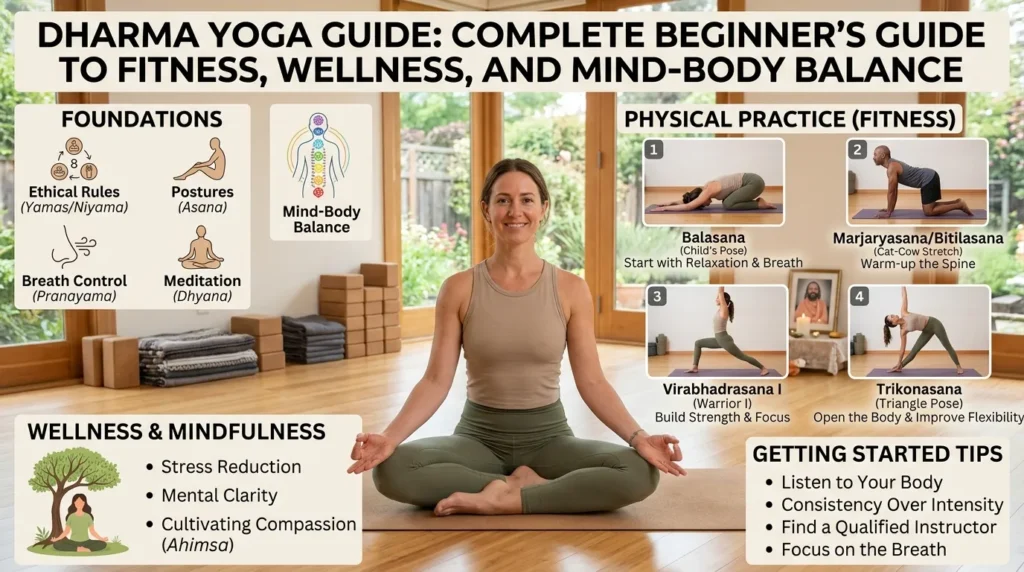

Imagine starting your day feeling stressed, tired, and mentally distracted. You spend hours sitting at a desk, your muscles feel tight, and your energy levels seem low. Now imagine spending just 30 to 45 minutes practicing a yoga system that combines physical movement, breathing exercises, meditation, and mindfulness. By the end of the session, your body feels stronger, your mind feels calmer, and your energy feels renewed. This is one of the reasons why many people are discovering the benefits of Dharma Yoga.
Dharma Yoga is a traditional yet practical style of yoga that focuses on physical health, mental clarity, spiritual growth, and overall wellness. It combines classic yoga poses, breathing techniques, relaxation practices, and meditation into one balanced system. For beginners, athletes, gym users, and health-conscious individuals, Dharma Yoga offers a complete approach to fitness and wellness.
This Dharma Yoga Guide explains what Dharma Yoga is, how it works, its health benefits, daily routines, best yoga exercises, advantages, limitations, and practical tips for beginners. Whether your goal is flexibility, strength, stress relief, weight management, or overall fitness with yoga, this guide will help you get started confidently.
What is Dharma Yoga?
Dharma Yoga is a comprehensive yoga practice developed from traditional yogic principles. It emphasizes physical postures, breathing control, meditation, self-discipline, and compassionate living.
Unlike some modern fitness-focused yoga styles, Dharma Yoga combines physical fitness with mental and spiritual development. The goal is not only to improve the body but also to create harmony between the body, mind, and breath.
Key Features of Dharma Yoga
- Traditional yoga principles
- Physical postures (Asanas)
- Breathing exercises (Pranayama)
- Meditation practices
- Relaxation techniques
- Mind-body awareness
- Personal growth and self-discipline
This balanced approach makes Dharma Yoga suitable for people of various fitness levels.
Benefits of Dharma Yoga
Dharma Yoga provides numerous physical, mental, and emotional benefits.
Physical Health Benefits
Regular Dharma Yoga practice can improve:
- Flexibility
- Balance
- Core strength
- Posture
- Joint mobility
- Muscle endurance
Many beginners notice improvements in body movement and flexibility within a few weeks.
Mental Health Benefits
Mental wellness is one of the strongest advantages of Dharma Yoga.
Benefits include:
- Reduced stress
- Better concentration
- Improved emotional control
- Enhanced mental clarity
- Better sleep quality
Many practitioners feel calmer and more focused after each session.
Weight Loss Support
Although Dharma Yoga is not primarily a weight-loss program, it can support healthy weight management.
Benefits include:
- Increased daily activity
- Better body awareness
- Reduced emotional eating
- Improved metabolism
- Greater exercise consistency
Combining yoga with healthy nutrition often produces excellent results.
Working Principle of Dharma Yoga
Dharma Yoga works by integrating movement, breathing, and awareness.
Breathing and Body Control
Controlled breathing is a major part of Dharma Yoga.
Benefits include:
- Better oxygen delivery
- Improved endurance
- Enhanced relaxation
- Greater focus
Proper breathing helps students maintain control during yoga poses.
Mind-Body Connection
Dharma Yoga encourages practitioners to become more aware of their bodies.
This awareness helps improve:
- Movement quality
- Balance
- Coordination
- Posture
The stronger the mind-body connection, the better the overall yoga experience.
Progressive Development
Yoga improvement occurs gradually through:
- Consistent practice
- Correct technique
- Controlled breathing
- Patience
This makes Dharma Yoga suitable for beginners and advanced students alike.
Types of Yoga Related to Dharma Yoga Practice
Understanding different yoga styles helps beginners choose the right path.
Beginner Yoga
Beginner Yoga focuses on:
- Basic poses
- Breathing techniques
- Safe movement patterns
This is usually the best starting point.
Hatha Yoga
Hatha Yoga uses slower movements and longer holds.
Benefits include:
- Improved flexibility
- Better posture
- Increased relaxation
Many Dharma Yoga classes include Hatha Yoga elements.
Vinyasa Yoga
Vinyasa Yoga connects movement with breathing.
Features include:
- Flowing sequences
- Moderate intensity
- Improved cardiovascular fitness
Power Yoga
Power Yoga is more physically demanding.
Benefits include:
- Greater strength
- Increased calorie burn
- Improved endurance
Athletes often enjoy this style.
Meditation Yoga
Meditation Yoga emphasizes:
- Mental clarity
- Stress reduction
- Emotional balance
It complements the physical aspects of Dharma Yoga.
Daily Yoga Routine for Beginners
A simple daily yoga routine can help build consistency.
Warm-Up Exercises
Start with gentle movements:
- Neck rolls
- Shoulder circles
- Arm swings
- Hip rotations
- Light stretching
Warm-ups prepare muscles and joints for exercise.
Basic Yoga Poses
Beginners should practice:
- Mountain Pose
- Child’s Pose
- Cobra Pose
- Tree Pose
- Cat-Cow Stretch
These poses build confidence and flexibility.
Breathing Exercises
Breathing exercises may include:
- Deep belly breathing
- Slow nasal breathing
- Controlled exhalation
Breathing improves relaxation and focus.
Cool Down
Finish each session with:
- Gentle stretching
- Relaxed breathing
- Short meditation
Cooling down supports recovery and relaxation.
Best Yoga Poses for Fitness
Several yoga poses are particularly effective for improving fitness.
Mountain Pose
Mountain Pose helps improve:
- Posture
- Balance
- Body awareness
It serves as a foundation for many other poses.
Cobra Pose
Cobra Pose strengthens:
- Lower back
- Core muscles
- Spine-supporting muscles
It also helps counteract poor posture.
Tree Pose
Tree Pose develops:
- Balance
- Focus
- Leg strength
It is excellent for beginners.
Warrior Pose
Warrior Pose improves:
- Strength
- Stability
- Endurance
It is commonly used in fitness-focused yoga sessions.
Downward Dog
Benefits include:
- Full-body stretching
- Improved flexibility
- Shoulder strength
It remains one of the best yoga exercises for overall fitness.
Advantages of Dharma Yoga
Dharma Yoga offers several important benefits.
Comprehensive Wellness
It addresses:
- Physical fitness
- Mental wellness
- Emotional balance
Few fitness systems provide such a complete approach.
Suitable for Beginners
Most Dharma Yoga practices can be modified for different fitness levels.
Low Equipment Requirement
You typically need only:
- Yoga mat
- Comfortable clothing
- Open space
Supports Long-Term Health
Regular practice can contribute to:
- Better mobility
- Improved posture
- Reduced stress
- Healthy aging
Disadvantages or Limitations
Despite its many benefits, Dharma Yoga has some limitations.
Slower Results for Muscle Growth
Yoga improves strength but may not build muscle as quickly as resistance training.
Requires Consistency
Results depend heavily on regular practice.
Flexibility Challenges
Some beginners may initially find certain poses difficult.
Not a Complete Athletic Program
Athletes may still need:
- Strength training
- Sport-specific conditioning
- Cardiovascular exercise
Applications of Dharma Yoga
Dharma Yoga can be applied in many areas of life.
Fitness and Wellness
Many people use Dharma Yoga for:
- Daily fitness
- Flexibility improvement
- Stress management
Athletic Performance
Athletes benefit through:
- Mobility improvements
- Faster recovery
- Better balance
Workplace Health
Office workers use yoga to reduce:
- Back pain
- Stress
- Poor posture
Healthy Aging
Older adults often practice yoga to maintain:
- Balance
- Mobility
- Independence
Difference Between Yoga and Gym Workout
Both yoga and gym workouts have value.
| Feature | Dharma Yoga | Gym Workout |
|---|---|---|
| Flexibility | Excellent | Moderate |
| Strength | Moderate | Excellent |
| Stress Relief | Excellent | Moderate |
| Balance | Excellent | Moderate |
| Mobility | Excellent | Good |
| Muscle Growth | Moderate | Excellent |
| Mindfulness | Excellent | Limited |
| Cardio Fitness | Moderate | Excellent |
| Equipment Needed | Minimal | Often Required |
Which Is Better?
The answer depends on your goals.
For complete fitness and wellness, combining yoga with gym workouts often produces the best results.
Selection Guide for Beginners
Choosing the right Dharma Yoga program is important.
Assess Your Fitness Level
Beginners should focus on:
- Basic classes
- Gentle yoga sessions
- Beginner instruction
Define Your Goals
Ask yourself:
- Do I want stress relief?
- Do I want flexibility?
- Do I want weight-loss support?
Your goals will guide your practice.
Learn Proper Technique
Working with a qualified instructor helps:
- Prevent injuries
- Improve form
- Increase confidence
Progress Gradually
Avoid rushing into advanced poses.
Consistency is more important than intensity.
Common Problems and Solutions
Problem: Poor Flexibility
Solution:
Practice regularly and avoid forcing stretches.
Problem: Balance Issues
Solution:
Use a wall or chair for support during standing poses.
Problem: Breathing Difficulties
Solution:
Slow down and focus on steady breathing patterns.
Problem: Lack of Motivation
Solution:
Set small weekly goals and maintain a schedule.
Problem: Muscle Soreness
Solution:
Stay hydrated, stretch gently, and allow recovery time.
Future Trends in Fitness and Yoga
The fitness industry continues to evolve.
Hybrid Fitness Programs
More programs now combine:
- Yoga
- Strength training
- Functional fitness
Virtual Yoga Classes
Online yoga platforms continue growing in popularity.
Personalized Wellness Programs
Technology is making customized fitness plans more accessible.
Wearable Fitness Devices
Smart devices help monitor:
- Heart rate
- Recovery
- Activity levels
Mindfulness and Mental Wellness
Future fitness programs will likely place even greater emphasis on mental health and stress management.
Conclusion
Dharma Yoga offers a powerful combination of physical fitness, mental wellness, breathing control, and personal growth. Unlike many exercise programs that focus only on physical results, Dharma Yoga encourages a balanced approach that strengthens both body and mind.
For beginners, it provides a safe and accessible path toward better flexibility, improved posture, enhanced balance, reduced stress, and greater overall health. Athletes, gym users, and wellness enthusiasts can also benefit from its focus on mobility, recovery, and mindfulness. While it may not replace every aspect of traditional strength training, it serves as an excellent complement to most fitness programs.
The key to success with Dharma Yoga is consistency. Small daily improvements can lead to significant long-term results. By combining regular practice, proper breathing, mindful movement, and healthy lifestyle habits, you can build a stronger, healthier, and more balanced life through Dharma Yoga.