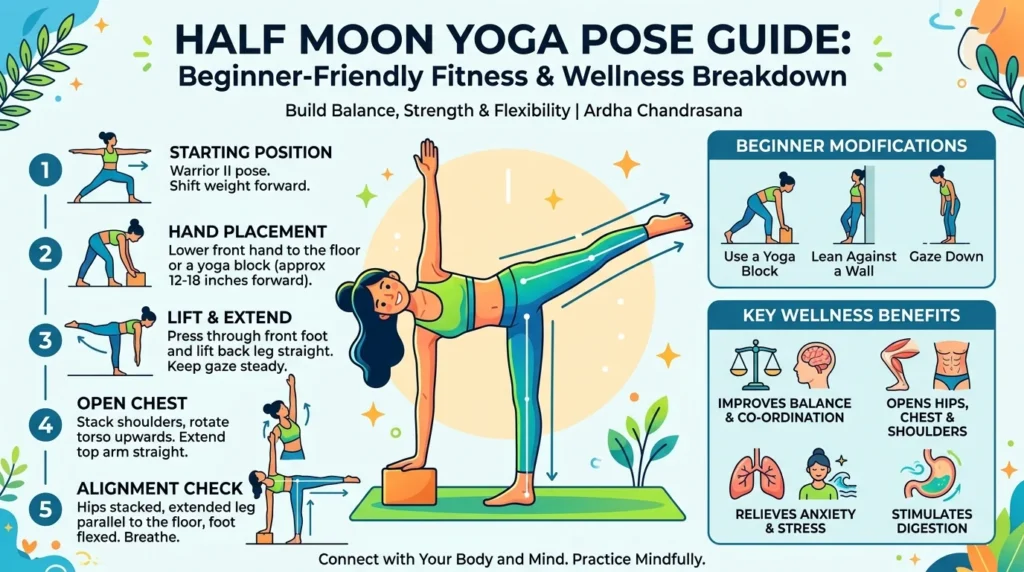

Imagine you’re in a yoga class, standing on one leg while your body slowly opens sideways, one hand reaching toward the floor and the other pointing toward the sky. At first, it feels impossible to balance. Your leg shakes, your core tightens, and your focus sharpens. But after a few tries, something changes—you feel stable, strong, and surprisingly calm. That is the experience of practicing the Half Moon Yoga Pose Guide, also known as Ardha Chandrasana.
This pose is widely used in modern yoga classes, physical therapy routines, and athletic training programs because it builds strength, balance, and mental focus at the same time. Whether you are a beginner trying yoga for the first time, a gym user adding flexibility work, or an athlete improving coordination, this pose offers powerful benefits.
In this detailed guide, you will learn everything about the Half Moon Yoga Pose Guide—how to do it correctly, its benefits, variations, mistakes to avoid, beginner modifications, breathing techniques, and how it fits into a daily yoga routine. You will also explore its connection to fitness, gym training, and overall wellness so you can confidently include it in your lifestyle.
What is Half Moon Yoga Pose (Ardha Chandrasana)?
The Half Moon Yoga Pose Guide explains Ardha Chandrasana, a standing balance pose in yoga where the body forms a half-moon shape.
Simple Definition
Half Moon Pose is a yoga posture where:
- You balance on one leg
- The other leg is lifted horizontally
- One hand supports you on the ground or a block
- The other arm stretches upward
Key Idea Behind the Pose
The main goal is to create:
- Balance
- Strength
- Flexibility
- Body awareness
It looks simple, but it challenges almost every muscle group in the body.
Benefits of Half Moon Yoga Pose Guide
The Half Moon Yoga Pose Guide offers benefits for both physical and mental health, making it a full-body wellness exercise.
Physical Health Benefits
1. Improves Balance and Stability
This pose strengthens stabilizing muscles in the ankles, knees, and hips.
2. Strengthens Core Muscles
Your abs and lower back work hard to keep you steady.
3. Builds Leg Strength
Standing leg muscles become stronger and more stable.
4. Enhances Flexibility
Hamstrings, hips, and shoulders stretch deeply.
5. Supports Posture Alignment
It helps correct slouching and improves body posture.
Mental Health Benefits
1. Improves Focus
You must concentrate fully to hold the pose.
2. Reduces Stress
Slow breathing and balance create mental calmness.
3. Builds Confidence
Mastering balance improves self-belief.
Weight Loss Support
While yoga is not high-intensity cardio, this pose:
- Activates multiple muscle groups
- Increases calorie burn
- Supports fat metabolism when combined with a routine
Breathing and Body Control
The pose improves:
- Breath control
- Mind-body coordination
- Awareness of movement
Working Principle of Half Moon Pose
The Half Moon Yoga Pose Guide works on three main principles:
1. Weight Distribution
Your body weight shifts onto one leg, improving control and strength.
2. Core Engagement
Your core stabilizes the entire body to prevent falling.
3. Open Hip Structure
The lifted leg opens the hip joint, improving mobility.
These combined actions improve functional fitness and athletic performance.
Types of Yoga That Support Half Moon Pose
The Half Moon Pose is often included in different yoga styles.
Hatha Yoga
- Slow and controlled movements
- Best for beginners
- Focus on alignment
Vinyasa Yoga
- Flow-based movement
- Connects breath with motion
- Improves endurance
Power Yoga
- Fitness-focused yoga style
- Builds strength and stamina
- Great for athletes
Meditation Yoga
- Focuses on breathing and awareness
- Helps mental relaxation
Daily Yoga Routine for Beginners
A simple routine helps beginners master the Half Moon Yoga Pose Guide.
Warm-Up Exercises
- Neck rolls
- Shoulder circles
- Light jogging in place
- Side stretches
Basic Yoga Flow
- Mountain Pose (Tadasana)
- Forward Bend
- Warrior Pose
- Half Moon Pose
- Child’s Pose for recovery
Best Yoga Poses for Fitness
These poses complement Half Moon Pose:
Mountain Pose (Tadasana)
- Improves posture
- Builds grounding
Cobra Pose (Bhujangasana)
- Strengthens spine
- Opens chest
Tree Pose (Vrikshasana)
- Builds balance
- Strengthens legs
Warrior Pose
- Builds strength
- Improves stamina
Advantages and Disadvantages of Half Moon Yoga Pose Guide
Advantages
- Improves full-body balance
- Strengthens muscles
- Enhances flexibility
- Reduces stress
- Boosts coordination
Disadvantages / Limitations
- Difficult for absolute beginners
- Requires good balance
- Can cause strain if done incorrectly
- Not ideal for severe knee injuries
Applications of Half Moon Yoga Pose
The Half Moon Yoga Pose Guide is used in:
Fitness Training
- Core strengthening
- Mobility improvement
Sports Training
- Improves agility
- Enhances coordination
Rehabilitation
- Helps in physical therapy
- Improves joint stability
Daily Wellness
- Reduces stress
- Improves posture
Difference Between Yoga and Gym Workout
| Feature | Yoga (Half Moon Pose) | Gym Workout |
|---|---|---|
| Focus | Balance, flexibility, mind-body control | Muscle growth, strength |
| Equipment | None | Machines, weights |
| Intensity | Low to medium | Medium to high |
| Mental Benefits | High | Moderate |
| Injury Risk | Low (if done correctly) | Moderate |
| Goal | Wellness & flexibility | Muscle building |
Both complement each other for complete fitness.
Selection Guide for Beginners
If you are new to yoga, follow these tips:
Start Slow
Do not rush into advanced poses.
Use Support
Use a yoga block or wall for balance.
Focus on Breathing
Breath control is more important than perfection.
Practice Daily
Consistency matters more than intensity.
Common Problems & Solutions
Problem: Losing Balance
Solution:
Focus your gaze on a fixed point.
Problem: Leg Shaking
Solution:
Strengthen your core with simple exercises.
Problem: Wrist Pain
Solution:
Use a yoga block for support.
Problem: Tight Hamstrings
Solution:
Do light stretching before practice.
Future Trends in Fitness and Yoga
The Half Moon Yoga Pose Guide is becoming popular in modern fitness trends.
1. Yoga in Fitness Gyms
Gyms now include yoga sessions for flexibility training.
2. Online Yoga Classes
Virtual training makes yoga accessible worldwide.
3. AI-Based Yoga Coaching
Apps guide posture correction using AI technology.
4. Hybrid Workouts
Yoga combined with strength training is becoming popular.
How to Do Half Moon Yoga Pose Step by Step
Step 1: Start in Standing Position
Stand tall with feet together.
Step 2: Shift Weight
Move weight onto one leg.
Step 3: Lean Forward
Place one hand on the floor or block.
Step 4: Lift Opposite Leg
Raise your back leg parallel to the ground.
Step 5: Open Your Chest
Stretch the top arm upward.
Step 6: Hold and Breathe
Maintain balance for 15–30 seconds.
Step 7: Return Slowly
Come back to standing position gently.
Breathing Technique
Inhale
Prepare and lengthen your spine.
Exhale
Enter the pose slowly and maintain balance.
Steady Breathing
Helps maintain stability and focus.
Safety Tips
- Do not force the pose
- Avoid jerky movements
- Use support if needed
- Stop if you feel pain
- Warm up before practice
Conclusion
The Half Moon Yoga Pose Guide is more than just a balance exercise—it is a complete mind-body workout that improves strength, flexibility, focus, and coordination. Whether you are a beginner starting your yoga journey or an athlete looking to enhance performance, this pose offers valuable benefits.
By practicing regularly, you develop better posture, stronger core muscles, and improved mental clarity. It also supports stress relief and enhances overall wellness, making it an important part of modern fitness routines.
Yoga is not about perfection—it is about progress. With consistent practice, patience, and proper technique, the Half Moon Pose becomes easier and more enjoyable. Combine it with other yoga poses, breathing exercises, and a healthy lifestyle to experience full-body transformation.
Start small, stay consistent, and let your yoga journey build strength from the inside out.