
If you are serious about building a strong, balanced, and athletic physique, the Push-Pull-Legs (PPL) split is one of the most effective training systems you can follow. Among these training days, the Pull Day Workout Routine plays a critical role in developing your back, biceps, and rear shoulder muscles—areas that define upper-body strength and posture.
In today’s modern lifestyle, many people spend long hours sitting at desks, driving, or using smartphones. This sedentary routine often leads to weak back muscles, poor posture, tight shoulders, and reduced mobility. Over time, this can cause discomfort, fatigue, and even long-term health issues. That’s why structured resistance training like pull day workouts has become more important than ever.
Fitness culture in the United States has evolved significantly over the past few decades. From old-school bodybuilding gyms to modern fitness centers with advanced equipment, training has become more accessible, science-based, and beginner-friendly. Today, millions of Americans use structured routines like pull day training to improve strength, burn fat, and build lean muscle efficiently.
This comprehensive guide will walk you through everything you need to know about a Pull Day Workout Routine—including exercises, training principles, gym equipment, nutrition, recovery strategies, and practical beginner tips.
Understanding Fitness and Its Importance
Fitness is the ability of your body to perform daily activities efficiently while maintaining strength, endurance, and overall health. It is not just about appearance—it is about how well your body functions.
A complete fitness foundation includes:
- Muscular strength
- Cardiovascular endurance
- Flexibility
- Mobility
- Balance
- Mental wellness
Why Exercise Matters in Daily Life
Regular exercise improves both physical and mental well-being.
Physical Benefits
- Helps with weight management
- Builds lean muscle
- Improves heart health
- Strengthens bones and joints
- Boosts stamina and energy
Mental Benefits
- Reduces stress and anxiety
- Improves sleep quality
- Enhances focus and productivity
- Builds confidence and self-esteem
Consistency is the key factor that determines long-term fitness success.
What Is a Pull Day Workout Routine?
A Pull Day Workout focuses on all the muscles involved in pulling movements. These include:
- Back muscles (latissimus dorsi, traps, rhomboids)
- Biceps (front of the arms)
- Rear deltoids (back of shoulders)
- Forearms
Pull movements are essential for building a strong upper body and improving posture.
Why Pull Day Training Is Important
- Builds a wide, strong back
- Improves posture and spinal alignment
- Enhances grip strength
- Strengthens biceps and arms
- Balances push day training
Without pull training, your upper body development becomes incomplete and unbalanced.
Benefits of a Pull Day Workout Routine
Builds a Strong Back
A strong back supports nearly every movement in daily life, from lifting objects to maintaining posture.
Improves Posture
Pull exercises counteract the forward rounding caused by sitting and screen time.
Increases Arm Strength
Biceps and forearms get direct stimulation from pulling exercises.
Enhances Athletic Performance
A strong pulling chain improves performance in sports like swimming, wrestling, and rowing.
Supports Fat Loss
Strength training increases calorie burn and improves metabolism.
Types of Fitness Training You Should Know
Strength Training
Focuses on building muscle and increasing force production.
Cardio Training
Improves heart health and burns calories:
- Running
- Cycling
- Walking
- Swimming
HIIT (High-Intensity Interval Training)
Short bursts of intense activity followed by rest periods.
Weightlifting
Uses external resistance like barbells and dumbbells.
Functional Training
Mimics real-life movement patterns:
- Pulling
- Carrying
- Lifting
Flexibility Training
Improves mobility and reduces injury risk.
Bodyweight Training
Uses your body as resistance:
- Pull-ups
- Push-ups
- Planks
Best Pull Day Exercises (Complete Breakdown)
Pull-Ups
One of the most powerful back-building exercises.
Muscles Worked
- Lats
- Biceps
- Upper back
Benefits
- Builds width in the back
- Improves grip strength
- Increases upper-body strength
Lat Pulldown
A beginner-friendly alternative to pull-ups.
Benefits
- Builds lat width
- Improves pulling strength
- Easy to control form
Barbell Bent-Over Row
A foundational compound movement.
Muscles Worked
- Mid-back
- Lats
- Biceps
Benefits
- Builds thickness in the back
- Improves posture
Dumbbell Row
Great for unilateral strength and muscle balance.
Seated Cable Row
Excellent for controlled resistance and back activation.
Face Pulls
Targets rear delts and upper back.
Benefits
- Improves shoulder health
- Fixes posture issues
Barbell Deadlift
One of the most powerful full-body exercises.
Muscles Worked
- Back
- Glutes
- Hamstrings
- Core
Dumbbell Bicep Curl
Isolates the biceps for arm growth.
Hammer Curl
Targets biceps and forearms.
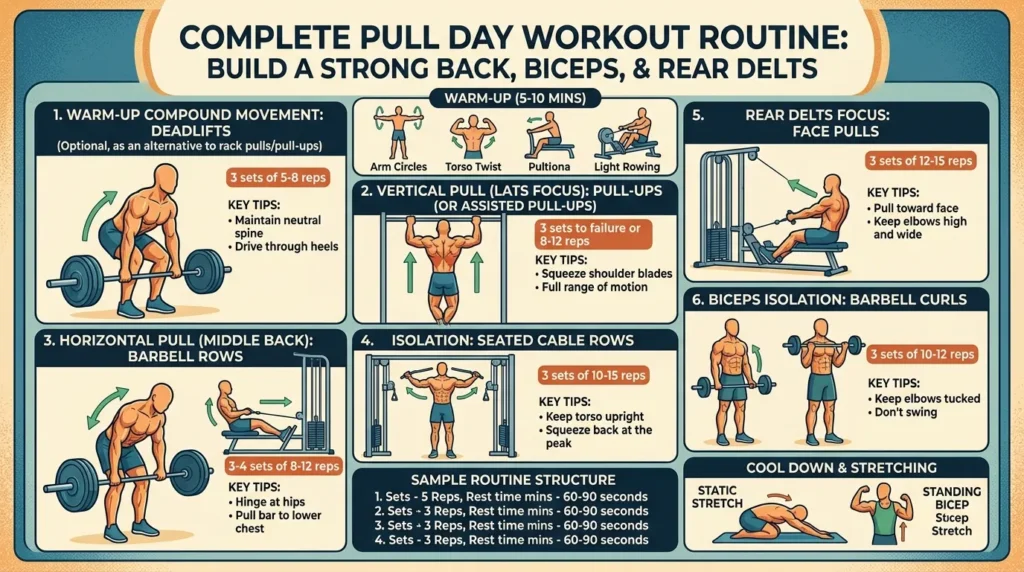
Complete Pull Day Workout Routine (Beginner Friendly)
Exercise 1: Lat Pulldown
- 3 sets
- 10–12 reps
Exercise 2: Barbell Row
- 3 sets
- 8–10 reps
Exercise 3: Seated Cable Row
- 3 sets
- 10–12 reps
Exercise 4: Face Pulls
- 3 sets
- 12–15 reps
Exercise 5: Dumbbell Curl
- 3 sets
- 10–12 reps
Exercise 6: Hammer Curl
- 3 sets
- 10 reps
Exercise 7: Deadlift (Optional Advanced)
- 3 sets
- 5–8 reps
This routine ensures balanced back and arm development.
Importance of Proper Form in Pull Training
Correct technique is essential for:
- Injury prevention
- Muscle activation
- Strength improvement
- Long-term progress
Key Form Tips
- Keep your back straight
- Avoid jerky movements
- Control weight on the way down
- Engage your core
Common Gym Equipment and Their Uses
Dumbbells
Used for rows, curls, and unilateral training.
Barbells
Best for heavy compound movements like deadlifts and rows.
Treadmills
Used for cardio, fat loss, and endurance training.
Resistance Machines
Ideal for beginners to learn controlled movement patterns.
Cable Machines
Provide constant tension for back and arm exercises.
Exercise Bikes
Low-impact cardio for endurance and fat loss.
Rowing Machines
Full-body cardio + strength combination.
Smith Machine
Offers guided bar movement for safer lifting.
Pull Day and Weight Loss Connection
Although pull workouts focus on muscle building, they also support fat loss by:
- Increasing calorie burn
- Building lean muscle
- Boosting metabolism
- Improving body composition
Combining pull day workouts with cardio creates a highly effective fat-loss strategy.
Beginner Tips for Pull Day Training
Start Light
Focus on learning movement patterns before increasing weight.
Train Consistently
2–3 pull sessions per week are ideal.
Focus on Mind-Muscle Connection
Feel the muscle working during each rep.
Track Progress
Keep a workout log for strength improvements.
Nutrition for Pull Day Performance
Protein Intake
Supports muscle repair and growth:
- Chicken
- Fish
- Eggs
- Greek yogurt
- Lean beef
Healthy Carbohydrates
Provide energy for workouts:
- Rice
- Oats
- Potatoes
- Fruits
Healthy Fats
Support hormone health:
- Nuts
- Avocados
- Olive oil
Pre-Workout Nutrition
Eat 1–2 hours before training:
- Banana with peanut butter
- Oatmeal
- Eggs and toast
Post-Workout Nutrition
Helps recovery and muscle growth:
- Protein shake
- Chicken and rice
- Yogurt with fruit
Hydration and Recovery
Why Water Matters
- Improves performance
- Supports muscle function
- Prevents fatigue
Sleep Importance
Aim for 7–9 hours of sleep for:
- Muscle recovery
- Hormone balance
- Energy restoration
Rest Days
Rest allows muscles to repair and grow stronger.
Common Mistakes to Avoid on Pull Day
Using Too Much Weight
Leads to poor form and injuries.
Ignoring Back Muscles
Focus equally on back and arms.
Skipping Warm-Ups
Increases injury risk.
Inconsistent Training
Progress requires discipline and routine.
Building Long-Term Fitness Success
Success in fitness comes from:
- Consistency
- Progressive overload
- Proper nutrition
- Recovery
- Patience
Small improvements over time lead to major transformations.
Conclusion
A well-structured Pull Day Workout Routine is essential for building a strong back, powerful biceps, and balanced upper-body development. It not only improves physical strength and posture but also enhances athletic performance, boosts metabolism, and supports long-term fitness goals. By combining proper exercise technique, consistent training, balanced nutrition, and adequate recovery, anyone—from beginners to advanced lifters—can achieve impressive and lasting results. Stay consistent, focus on form, and trust the process, and your fitness transformation will follow.